
Academy · Course guide
How to choose a paramedical tattoo course
A buyer's guide to paramedical and camouflage tattoo training in Ontario and Canada: what to check in the curriculum, live models, class size, mentorship, kits and red flags.
Paramedical tattoo training has become one of the most searched beauty courses in Canada, and the number of options has grown just as quickly. Some courses are a few hours long; others include months of support. Some are taught by specialists who camouflage scars every week; others by educators for whom camouflage is one module among many. Choosing well matters, because the skills you learn will touch real people's skin and confidence. This guide gives you a practical checklist.
Start with your goal
Be clear about why you are training:
- A new career from scratch, perhaps alongside family life.
- Adding a service to an existing salon, spa, clinic or PMU business.
- Moving from barbering, SMP or tattooing into scar and skin camouflage.
Your starting point shapes what you need. A complete beginner needs more time on skin fundamentals and supervised practice; an experienced PMU artist may need more on scar assessment and colour for body skin.
1. Who is teaching?
The single biggest factor is the educator. Ask:
- How long have they worked in camouflage specifically, not just tattooing in general?
- Do they still treat clients regularly?
- Can you see their healed camouflage results, across different skin tones?
- Have they been invited to teach or speak at industry events?
At SKINEAV Academy you train with Evelyn Alvares Vega, who has more than 10 years in paramedical tattooing and was invited to share camouflage education at WULOP Canada 2026.
2. What does the curriculum cover?
A strong camouflage curriculum should include:
- Skin anatomy and how scars, stretch marks and vitiligo form.
- Client assessment: which marks are suitable, which are not, and when to say "wait".
- Contraindications and medical history.
- Colour theory, undertones and custom pigment mixing.
- Needle depth, machine settings and technique for different tissue.
- Healing, aftercare and touch-ups.
- Hygiene, infection prevention and Ontario personal service setting requirements.
- Consent, record keeping and photography.
- Pricing, consultations and marketing.
3. Is there real hands-on practice?
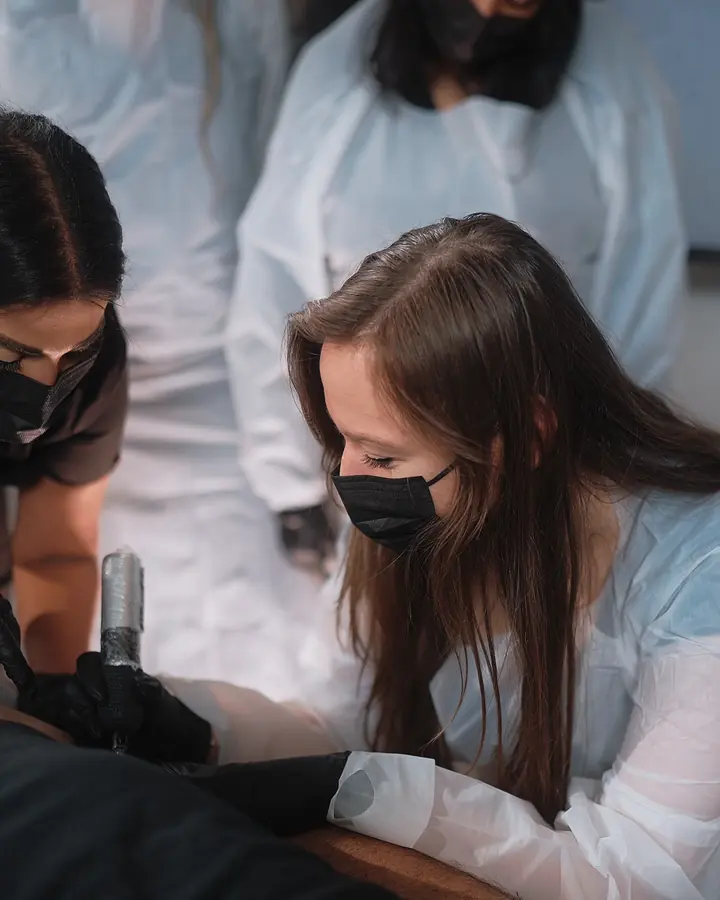
Theory alone will not make you confident. Ask how much time you spend practising on synthetic skin, and whether you work on live models under supervision. Find out who provides the models. In SKINEAV's in-person courses, you get supervised, hands-on practice on real clients.
4. How big is the class?
In a large group, you may get only minutes of the educator's attention. Small groups let the trainer watch your hand, correct your angle and answer questions in real time. SKINEAV offers 1:1 private training, small groups of up to 5, and a larger Masterclass format.
5. What happens after the course?
The hardest part often begins after training: your first real clients, a tricky colour, a healing question. Ongoing support makes a huge difference. Ask whether mentorship is included and for how long. SKINEAV includes six months of mentorship after the course, with extra time when you need it.
6. What is in the kit?
Check exactly what equipment comes with the course and whether it is professional grade. Can you start working with it, or will you need to buy more straight away? SKINEAV courses include all the equipment you need to start your own business.
7. How is it delivered?
Online, in person, or both? Each has trade-offs. Read online vs in-person camouflage training. SKINEAV courses run in person in Vaughan or online via Zoom.
8. Certification and regulations
Ask what certificate you receive and what it means. In Ontario, the business side of tattooing falls under personal service setting rules and local public health inspection. A course certificate is not a licence. A good course will explain what you need to set up compliantly. See paramedical tattoo rules in Ontario.
Red flags
- Promises of guaranteed income or "six figures" within months.
- No healed results from the educator.
- Very large classes with no live-model time.
- No discussion of contraindications or when not to treat.
- No support after the course ends.
- Pressure to pay immediately.
Questions to ask on a discovery call
- Can I see your healed work on different skin tones?
- How many students per class?
- How many live models will I work on?
- What exactly is in the kit?
- What support do I get after I finish?
- Is it suitable for beginners?
Comparing course formats in practice
When you compare options, it helps to build a simple table for yourself with these rows:
- Total training hours, and how many of those are hands-on.
- Number of live models you work on, and who supervises.
- Maximum class size.
- Educator's years in camouflage specifically.
- What is in the kit.
- Length and type of support afterwards.
- Format: in person, online, or both.
Filling this in for each course makes differences obvious. A short course may look cheaper but include far less practice or support. A longer course may include mentorship that saves you costly mistakes on your first clients.
What your first month after training should look like
A realistic plan after any good course:
- Practise on synthetic skin regularly to keep your hand steady.
- Treat a small number of portfolio clients, carefully chosen for suitability.
- Photograph healed results in consistent light, with written permission.
- Bring questions to your mentor, especially about colour and healing.
- Prepare your workspace and paperwork for public health requirements.
Learning never stops
Even experienced camouflage artists keep refining their colour work. Look for an educator who is still treating clients, still learning, and willing to keep answering your questions as you grow.
Why small groups matter for beginners
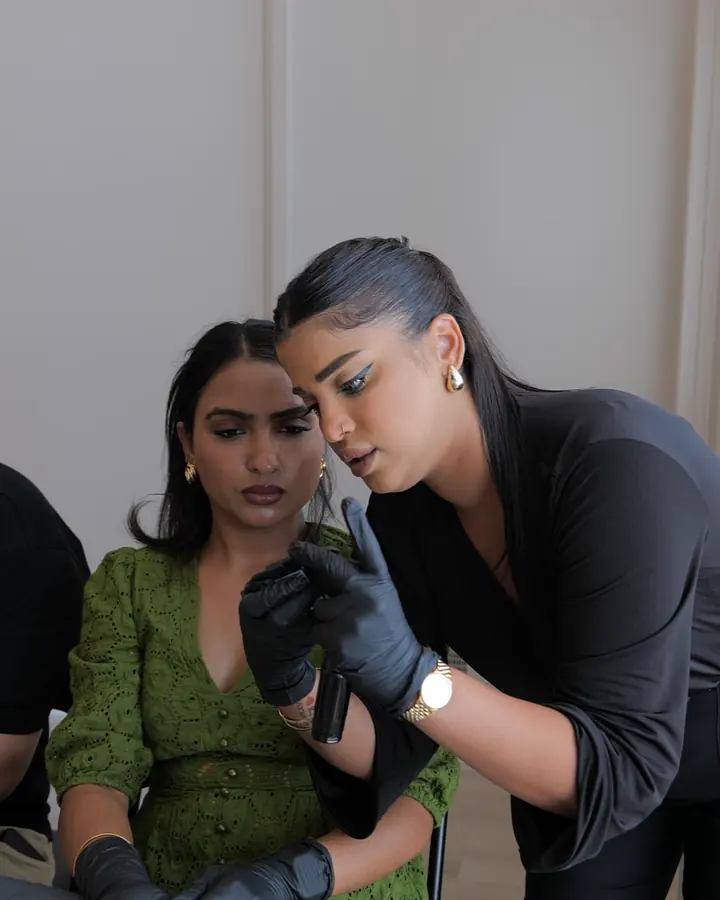
In a group of up to five, every student gets time with the educator at the table, not just at the front of the room. You can see your mistakes corrected immediately, ask the question you were embarrassed to ask in a big class, and see a variety of skin types close up. For beginners, that attention speeds up confidence enormously.
The SKINEAV approach
SKINEAV Academy courses run over 3 intensive days, about 5–7 hours each, with options for 1:1, small groups of up to 5, or Masterclass. Beginners are welcome. You leave with your SKINEAV certification, your equipment and six months of mentorship. Investment, dates and payment options are explained on a free call so you get an accurate answer for your situation. Courses start from $1,999, depending on the format and length. The in-person scar camouflage course runs 3 days in small groups of up to 5. Ask about current offers.
See the camouflage courses, download the free career guide, or text 647-492-4584 with questions.
Frequently asked questions
Can beginners take a paramedical tattoo course?
Yes. Many courses, including SKINEAV's, welcome complete beginners. Check that the course includes enough fundamentals and supervised practice.
How long is a paramedical tattoo course?
It varies widely. SKINEAV courses are 3 intensive days of about 5–7 hours each, followed by six months of mentorship.
Is a course certificate the same as a licence?
No. In Ontario, tattoo businesses follow personal service setting rules and local public health inspection. A good course explains this.
Are online camouflage courses worth it?
They can be for theory and flexibility, but supervised hands-on practice is essential. SKINEAV offers both formats.
How do I find out course dates and cost?
Book a free call or text 647-492-4584. Investment, dates and payment options are explained for the course that fits you. Courses start from $1,999, depending on the format and length. The in-person scar camouflage course runs 3 days in small groups of up to 5. Ask about current offers.
“In the beginning, your portfolio is everything. People need to see your work before they trust you with their skin.”
Evelyn Alvares Vega, SKINEAV Academy
Real results and real moments
How training works
- Free callTalk through your goals, the right format and current offers.
- Reserve your seatIn person in Vaughan or live online via Zoom.
- 3 intensive daysColour theory, technique and supervised practice with Evelyn.
- Six months of mentorshipFeedback on your work while you build your business.