
Technique · Colour
How skin colour matching really works
Undertones, depth, Fitzpatrick types, custom pigment mixing and colour tests: how camouflage artists match pigment to your skin, and why healed colour differs from fresh.
Colour matching is the heart of camouflage tattooing. A well-matched camouflage quietly blends in; a poorly matched one can draw more attention than the original mark. Understanding how matching works helps you know what to look for in an artist and why patience over several sessions pays off.
Skin is not one colour
When you look at skin, you see a single tone. In reality it is layered: the depth (how light or dark), the undertone (warm, cool, neutral or olive), and the way light passes through and reflects from the skin. Skin also varies across the body. Your abdomen, inner arm and the back of your hand are often different shades.
Depth and undertone
- Depth describes how light or dark the skin is. Artists often refer to the Fitzpatrick scale, which groups skin by how it responds to sun, as one rough reference.
- Undertone is the subtle hue beneath the surface: golden or peachy (warm), pink or rosy (cool), neutral, or olive.
Two people with the same depth can need completely different mixes because of undertone. Matching depth but missing undertone is one of the most common reasons camouflage looks "off".
Reading the skin around the mark
A camouflage artist looks at the skin immediately around the mark, not your face or an average. Good, natural-like lighting is important. Evelyn also considers how that skin changes with seasons, how much sun the area gets and how the mark itself reflects light.
Custom mixing
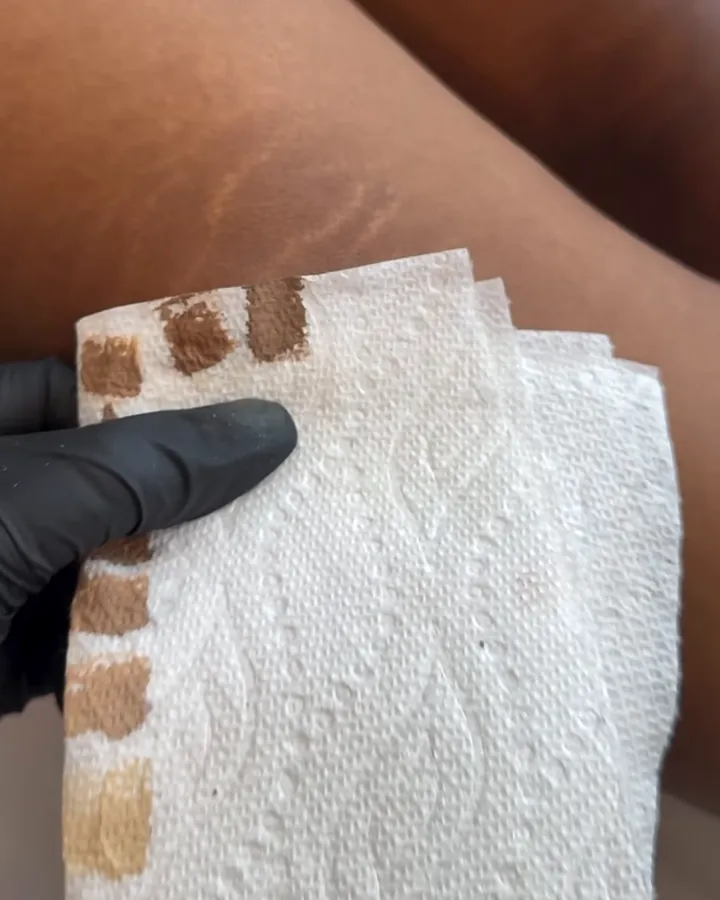
Rather than choosing a single ready-made shade, camouflage pigments are usually mixed for each client, sometimes with several mixes for different parts of an area. At SKINEAV, Evelyn formulates custom mixes for your skin. The aim is a colour that reads as yours once healed.
Why fresh colour looks different
Freshly placed pigment sits near the surface of healing skin and often looks brighter or darker than its final shade. As the skin heals over the following weeks, a thin layer of skin forms over the pigment and the colour softens. That is why:
- Colour tests are judged after healing, not just on the day.
- Sessions are spaced weeks apart.
- The next session refines the mix based on how your skin healed.
The colour test
A colour test places small amounts of candidate mixes in or near the area so you and your artist can see how they heal. It turns guesswork into evidence. At SKINEAV, the in-clinic consultation includes a colour test on your skin.
Seasons and sun
Pigment does not tan. If your skin deepens in summer, the camouflaged area may look lighter by contrast; in winter, the reverse. A good plan aims for your usual tone and accepts a small seasonal shift. Sun protection on treated and surrounding skin keeps the difference smaller and protects the pigment.
Scar tissue changes the equation
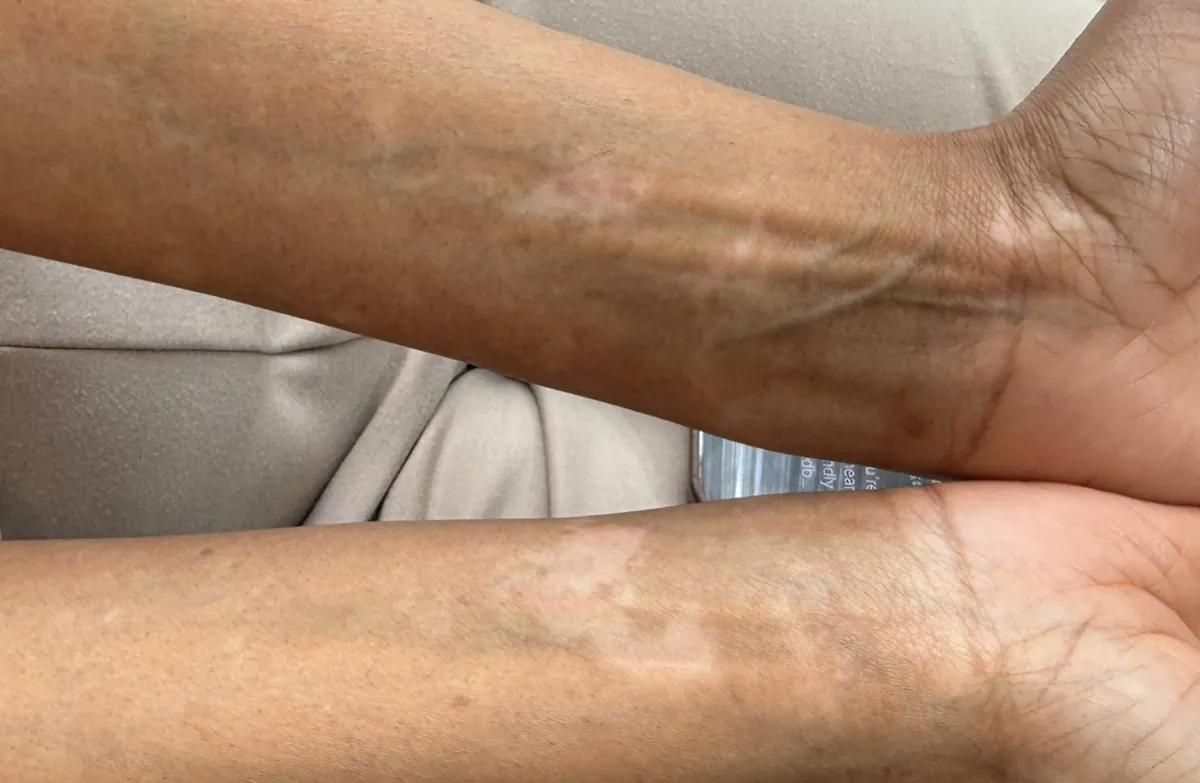
Scar tissue often lacks melanin and can be shinier or more translucent than normal skin. The same mix can look different in scar tissue than in surrounding skin. Artists account for this, sometimes adjusting mixes between the centre and the edge of a scar.
Skin of colour
Deep and medium skin tones are rich in undertone and can be more prone to pigment changes after injury. Careful mixing, test areas and gentle technique matter even more. Read vitiligo camouflage on brown and Black skin.
How to judge an artist's colour skill
- Ask to see healed results, ideally on a skin tone like yours.
- Ask how they choose undertones.
- Ask whether they mix custom colours or use one shade per skin type.
- Ask whether they test colour before treating.
- Notice whether they look at your skin in good light and take their time.
What this means for you
Good colour matching takes time, testing and patience. It is the reason camouflage is planned in stages and why it is a specialist discipline. Evelyn has more than 10 years in paramedical tattooing and teaches colour theory to other artists at the SKINEAV Academy.
Why the same colour looks different on different body parts
Body areas differ in thickness, blood flow and sun exposure. The inner arm is often lighter and cooler than the outer arm; the abdomen is usually lighter than the shoulders. A mix that disappears on one area can look slightly off on another. That is why camouflage plans often use more than one mix, and why the skin directly around the mark is the reference.
The role of light
Daylight, warm indoor light and cool office lights each reveal colour differently. Camouflage artists aim for a blend that looks natural in everyday light, accepting that very harsh or side lighting may still reveal some texture. When you judge your results, look in daylight rather than under a single overhead bulb.
Building colour in layers
Rather than placing a lot of pigment at once, camouflage is usually built in layers over sessions. This reduces the risk of overshooting the colour, gives the skin time to heal, and lets the artist respond to how your skin actually healed. A slightly too-light first session is much easier to adjust than a too-dark one.
What you can do to help
- Keep treated areas out of the sun while they heal.
- Use sunscreen long term.
- Attend follow-ups at the suggested interval.
- Tell your artist if your skin tone changes significantly, for example after a holiday or a change in medication.
A quick glossary
- Depth: how light or dark the skin is.
- Undertone: the subtle hue beneath the surface, such as warm, cool, neutral or olive.
- Custom mix: a pigment blended for one client, rather than a ready-made shade.
- Colour test: small amounts of candidate mixes placed and judged after healing.
- Healed colour: the final shade weeks after a session, usually softer than fresh.
- Touch-up: a later session to refresh or refine the blend.
Next step
To find out how your skin would respond, start with a free phone consult or a free photo assessment, then come in for a consultation with a colour test. Call or text 647-492-4584. SKINEAV is at 36 Bessemer Ct Unit 1, Vaughan, ON L4K 3C9, with free parking.
Frequently asked questions
How does a camouflage artist match my skin colour?
By reading the depth and undertone of the skin around the mark, custom-mixing pigment and testing it on your skin before treatment.
Why does my camouflage look darker right after?
Fresh pigment looks stronger. It usually softens over the following weeks as the skin heals.
Will the colour change in summer?
Pigment does not tan, so contrast may shift slightly with the seasons. Sun protection helps.
What is a colour test?
Small amounts of candidate mixes placed on your skin so the healed colour can be judged before full treatment.
Does colour matching work on deep skin?
Yes, with careful undertone mixing and test areas, because deeper skin needs precise blending.
“We don’t fix texture, we fix color.”
Evelyn Alvares Vega, founder of SKINEAV
Real results and real moments
How it works at SKINEAV
- Photo or callSend a photo or book a free phone consult. Honest first answer.
- Assessment & colour testIn clinic, Evelyn checks your skin and tests a custom formula.
- TreatmentPigment placed precisely, only where it is needed, one-on-one.
- Heal & reviewThe colour settles over weeks; follow-ups are planned if needed.