
Options · Comparison
Camouflage tattoo vs cover makeup
Comparing camouflage tattooing with corrective cover makeup for scars, stretch marks, vitiligo and birthmarks: commitment, daily effort, results and how to try before you decide.
If you have a scar, vitiligo, a birthmark or stretch marks that you sometimes want to tone down, there are two broad routes: corrective cover makeup that you apply and remove, or camouflage tattooing that stays in the skin. Both can work well. They suit different people, different areas and different lifestyles. This guide lays out the honest pros and cons of each.
Cover makeup: flexible and reversible
Corrective or camouflage makeup is designed to be more opaque and longer-wearing than everyday foundation. Used well, it can conceal strong contrast, including vitiligo patches and birthmarks.
Advantages
- Fully reversible. Wear it when you want, skip it when you don't.
- No healing time, no needles.
- Can be adjusted for seasonal skin changes.
- A great way to test how you feel about less contrast.
Drawbacks
- Daily time and effort, especially on the body.
- Can transfer onto clothes, smudge with sweat, or wash off in water.
- Harder on large areas such as the abdomen or legs.
- Ongoing product costs.
Camouflage tattooing: long-term and low-maintenance
Camouflage tattooing places custom-mixed, skin-toned pigment into lighter marks to reduce contrast. See what is paramedical tattooing.
Advantages
- No daily application.
- Works with swimming, sport and sweating once healed.
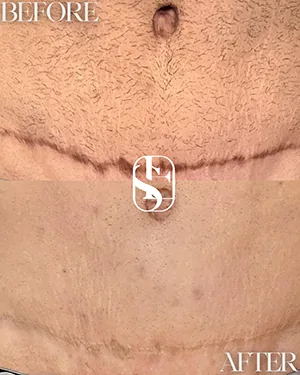
- Suited to large areas like stretch marks across the abdomen.
- Gives freedom in situations where makeup is impractical.
Drawbacks
- It is a tattoo: long-term, not easily reversed.
- Needs suitable skin: mature, stable, usually lighter than surrounding skin.
- Pigment does not tan; contrast can shift with the seasons.
- Usually more than one session, with healing time between.
- May need touch-ups over the years.
Which areas suit which?
- Face: many people prefer makeup for facial areas, or start with makeup. Facial camouflage tattooing needs careful assessment.
- Hands: makeup rubs off quickly, but tattoo pigment on hands can also fade faster. Case by case.
- Body (abdomen, thighs, arms, back): camouflage tattooing is often the more practical long-term choice for stretch marks and scars here.
- Darker marks (hyperpigmentation): these are the hardest to camouflage with pigment, so makeup is often the simpler answer, though some stable patches can be balanced with a custom formula.
Which marks suit which?
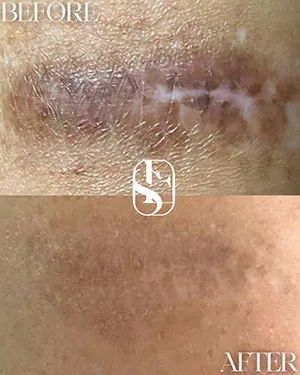
- Pale, mature scars and stretch marks: often good candidates for camouflage tattooing.
- Stable vitiligo: either; tattoo only after a stability discussion. See vitiligo camouflage on skin of colour.
- New, red or changing marks: makeup while you wait for them to settle.
- Dark birthmarks and pigmentation: case by case; often makeup or medical options. See birthmark and hyperpigmentation camouflage.
Try before you commit
Wearing cover makeup for a few weeks is a useful experiment. Notice how you feel when the contrast is less visible. If you love the freedom and dislike the daily routine, camouflage tattooing may be worth exploring. If you prefer the flexibility, makeup may be your long-term answer, and that is a perfectly good outcome.
Questions to ask yourself
- How often do I want this mark less visible: daily, sometimes, or only for events?
- Do I swim, sweat or play sport often?
- How large is the area?
- Am I comfortable with something long-term?
- Has the mark finished changing?
Using both
Some people use makeup on the face and camouflage tattooing on the body, or makeup while waiting for a scar to mature before camouflage. There is no rule that says you have to choose only one.
How to apply cover makeup well, if you choose it
If you are trying cover makeup, a few tips help:
- Match the surrounding skin, not your face. Body skin is often a different shade.
- Thin layers look more natural than one thick layer.
- Set with powder to reduce transfer onto clothing.
- Use a waterproof formula for the beach or the gym, and remove it gently at night.
- Test in daylight, since indoor light can be misleading.
Some pharmacies and makeup counters can help with colour matching for corrective products. Trying makeup this way is also a good way to see how a lower-contrast look feels before considering anything long-term.
How camouflage tattooing fits into daily life
Once healed, camouflage tattooing needs no daily routine beyond sun protection. Many clients describe the biggest benefit as time: no more getting up earlier to cover marks, no more worrying about transfer onto clothes. That freedom is the main reason people move from makeup to tattooing.
Costs over time
Makeup is a recurring cost, small but ongoing. Camouflage tattooing is a larger upfront investment, with occasional touch-ups. Neither is universally cheaper; it depends on how often you use makeup and how large the area is. Our article on camouflage cost factors explains what affects a camouflage quote.
A short self-test
Answer these quickly:
- I want the area less visible every single day. (Yes / No)
- I swim, sweat or play sport several times a week. (Yes / No)
- The area is larger than my palm. (Yes / No)
- The mark has stopped changing for many months. (Yes / No)
- I am comfortable with a long-term change. (Yes / No)
Mostly yes? Camouflage tattooing may be worth exploring. Mostly no? Cover makeup may suit you better, at least for now. Either way, a consultation can confirm what is realistic.
Next step
If you are curious whether camouflage tattooing suits a particular mark, send a daylight photo for a free photo assessment or book a free phone consult. Call or text 647-492-4584. SKINEAV is at 36 Bessemer Ct Unit 1, Vaughan, ON L4K 3C9, with free parking, and you will get an honest answer, including if makeup would be the better choice.
Frequently asked questions
Is camouflage tattooing better than makeup?
Neither is better for everyone. Makeup is flexible and reversible; camouflage tattooing is long-term and low-maintenance on suitable skin.
Can cover makeup be used on vitiligo?
Yes. Corrective makeup can be very effective on vitiligo and is a good way to try reduced contrast.
Can I wear makeup over a healing camouflage tattoo?
Avoid products on the area while it heals. Once healed, follow your artist's guidance.
Is camouflage tattooing reversible?
It is a tattoo, so it is not easily reversed. That is why careful assessment matters.
Which is better for dark birthmarks?
Dark birthmarks are among the hardest to camouflage. Some can be balanced with a custom formula; makeup or medical options are often simpler.
“We don’t fix texture, we fix color.”
Evelyn Alvares Vega, founder of SKINEAV
Real results and real moments
How it works at SKINEAV
- Photo or callSend a photo or book a free phone consult. Honest first answer.
- Assessment & colour testIn clinic, Evelyn checks your skin and tests a custom formula.
- TreatmentPigment placed precisely, only where it is needed, one-on-one.
- Heal & reviewThe colour settles over weeks; follow-ups are planned if needed.